
Try
& Buy From

Music Conducted By
Jerry Goldsmith
Orchestrations By
Arthur Morton
Trumpet Soloist
Uan Rasey
Recorded By
-
Performed By
-
Album Produced By
Jerry Goldsmith
Label
Intrada Special
Collection Volume ISC 350
Previous Release(s)
Varèse Sarabande
VCL 0512 1129
Varèse Sarabande
VSD-5677
ABC LP
MCA JAPAN LP
Year Of CD/Film Release
1995/1974
Running Time
72:18
Availability
Normal Release
Cues
&
Timings
1. Love Theme From Chinatown
(Main Title) (1:59)
2. Noah Cross (2:27)
3. Easy Living (Ralph Rainger & Leo Robin) (1:49)
4. Jake And Evelyn (2:41)
5. I Can't Get Started (Ira Gershwin & Vernon Duke) (3:35)
6. The Last Of Ida (2:59)
7. The Captive (3:05)
8. The Boy On A Horse (2:05)
9. The Way You Look Tonight (Jerome Kern & Dorothy Fields) (2:16)
10. The Wrong Clue (2:32)
11. J.J. Gittis (3:05)
12. Love Theme From Chinatown (End Title) (2:03)
Total Album Time: 31:23
Original Motion Picture Soundtrack
13. Love Theme From Chinatown (Main Title) (1:56)
14. J.J. Gittis (3:10)
15. Noah Cross I (1:32)
16. Mulwray's Office (1:29)
17. A Late Swim (0:25)
18. The Boy On A Horse (2:06)
19. Easy Living (Ralph Rainger & Leo Robin) (1:48)
20. The Way You Look Tonight (Jerome Kern & Dorothy Fields) (4:35)
21. Noah Cross II (1:11)
22. No Trespassing (0:55)
23. Some Day/The Vagabond King Waltz (Rudolf Friml & Brian Hooker) (3:18)
24. The Last Of Ida II (0:54)
25. Jake And Evelyn (2:46)
26. The Captive (3:15)
27. Second Thoughts (1:03)
28. The Last Of Ida I (2:50)
29. The Wrong Clue II (2:15)
30. The Wrong Clue I (1:19)
31. It's Not Worth It (1:11)
32. Love Theme From Chinatown (End Title) (2:01)
Total Soundtrack Time: 40:46
Soundtrack
Ratings
Disappointing

Functional

Average

Good

Excellent

Outstanding
|
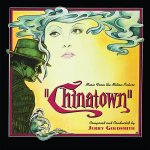
Chinatown
Jerry Goldsmith's replacement
score to Phillip Lambro's earlier effort is quite rightly regarded
as a classic score. Goldsmith turned out to be the perfect choice
(one of the few Hollywood composer to have grown up in the film's
period setting), to perfectly capture the mood of the piece,
and turning in his work in approximately 10 days! Although relatively
modest in duration Goldsmith's task was to climb a mountain and
provide the movie with an identity. Which is exactly what he
did with one of the finest themes ever written for a motion picture.
So good was the composer's 'hook' that legendary producer Robert
Evans commented that Goldsmith single handily saved the picture.
Jerry Goldsmith's masterful score to Chinatown features
quite an unusual ensemble; made up of strings, four pianos, four
harps, guiro, and solo trumpet, which the composer revealed he
saw in his head while watching the movie for the first time.
The latter instrument went on to define the film's film noir
aspect perfectly with its hypnotic bluesy theme (Main Title)
for Jack Nicholson's Private Eye, and love theme for the mysterious
Evelyn (Faye Dunaway). But the score to Chinatown has
a darker, more avant-garde heart to it. It's here that Goldsmith
presents a series of unsettling cues for the movie's thriller
and mystery elements, remaining a stark contrast to his memorable
opening theme.
Noah Cross introduces a kaleidoscope of sound from the
lowest registers with bells and harp joined by guiro to create
dissonance and motion, while strings and eventually trumpet resonate
on an alternate theme. Jake And Evelyn introduces a more
contemporary 70's sound with a beautiful reading of his main
theme; here Goldsmith capturing intimacy and anticipation with
tremolo strings and a delicate piano motif. The Last Of Ida
begins with a warmer rendition of Goldsmith's theme for Jake's
drive across L.A. before things turn decidedly dark with piano
and chimes. Dissonant strings build to a moment of classic Goldsmith
action writing as piano and snare drums rally, while the cue
signs out with more trumpet and harp. The Captive follows
on in a similar vain with piano creating tension, along with
shakers and guiro, again to create momentum. Descending strings
are now introduced along with castanets and distorted vocalisations,
that all prove more chilling than some of Goldsmith's latter
work for The Omen.
The Boy On A Horse introduces an eerie feeling of
melancholy with a new piano motif, that leads on to more sinister
work for strings. With The Wrong Clue and JJ Gites
building to the downbeat and dark final act, with a warmer rendition
of the love theme juxtaposed with more aggressive moments for
the drive to Chinatown and the use of more unnerving piano, harp
manipulations and closing with some deliriously giddy brass.
The score signs off with the End Title for another chance
to savour Goldsmith's memorable theme.
Originally issued on LP, it was finally preserved on CD by Varese
in 1995 and later again as part of their CD Club. Finally in
2016 we have the definitive presentation courtesy of Intrada Records which
presents the album content along with the full film soundtrack in a clean mono
source, from the late composer's own archive. An incredible moment in the
Goldsmith canon that sadly missed out on the Oscar, but will
be forever remembered as one of the truly great film scores.
|
|
|