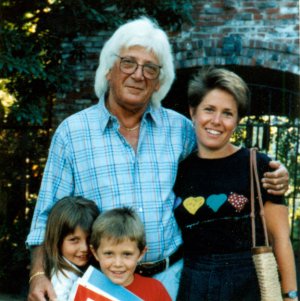
Preview of The Aborted Jerry
Goldsmith Biography
Prelude
My father was a renowned Hollywood film composer. If he were
alive, and not recently dead of cancer, he would read the preceding words and
correct me irritably: “Don’t call me a ‘film composer’,” he would have said.
“I’m a composer. You don’t refer to Mozart as an ‘opera’
composer.”
My father never minded admitting that once I had saved his life.
He would recount a night I called and woke him out of an almost endless slumber
fueled by Nembutal and Vodka without a trace of self-consciousness; to him, it
was just another amusing anecdote—and he did give me credit for being a hero.
And now I’m saving his life again; this time, to disc, hard drive
and paper. According to some cultures and traditions, when you save a person’s
life, you become responsible for that life until it ends. Some might argue that
my father will live on forever through his music, but I think forever is far too
long to be held responsible.
In 2004, I
left my home in New Hampshire and my job as a high school English teacher, to
live in Los Angeles and research my father’s life for a biography. During five
of the seven months preceding his death in July, I taped my father’s stories and
recollections. In addition, I interviewed and taped his friends and
associates.
When I started writing, stacks of notes, files of Xeroxed copies,
blurry photographs, a couple of sheets of ancient correspondence, and two
shoeboxes full of micro-cassettes surrounded me. I had pages and pages of
transcripts about creative brilliance and originality, charm and charisma,
integrity and decency, good times and laughs. Of course, I had my own version
of the story as well, and I found the task to reconcile all of it—daunting.
Stories have
a way of taking on a life of their own no matter how unbiased the teller’s
intent; everybody has a story, and each beats with a pulse beyond any kind of
doubt in the teller’s soul. When I started writing about my father, others’
stories kept poking through between the double-spaced lines. Even though I quote
from taped interviews, retell from personal experience, and refer to reliably
documented sources, versions and interpretations of the same event don’t always
align; each teller is the hero of their own story.
When I interviewed one of Dad’s associates, writer/director
Michael Crichton, he said to me, “I want to know what drives
Jerry.”
I wanted to know the same thing, but “…while death ends a life,”
as Robert Anderson writes in his play, I Never Sang for My Father, “It
does not end a relationship which struggles on in the survivor’s mind toward
some resolution which it never finds.”
Unlike most literature and movies, endings are not always tidy.
“…If I were a
producer or director and I was looking for someone to score a film, my first
choice would be Jerry Goldsmith. Jerry is uncompromising in his drive for
excellence, uncompromising in his bravery to experiment with other media. He is
the kind of composer that makes a film.”
Elmer Bernstein, composer
Excerpts From
Chapter 1: February 2, 2004
When I interviewed Dad for the first
time, we sat where we would sit for most of our sessions, in the den of his
house in Beverly Hills, under a giant, brazen Lichtenstein. The painting of
juxtaposed triangles and lines dominated the western wall of the room, and the
early, afternoon sun filtered in through opposing French doors. In spite of all
that light, in spite of the broad expanse of white backing up the blue, black,
and yellows in the Lichtenstein, in spite of the beige being more than the
darker spots in the faux-leopard-skin patterned carpet, the den, like many of
the rooms in my father and step-mother’s house, felt cool and dark. Maybe it
was the dark wood floors, or the almost black marble of the never been burnt in
fireplace, or the black cashmere couches where Dad was lying with his legs up.
A veteran of many interviews, he directed how I should set up the microphone and
tape recorder with a detached professionalism, and wisely suggested that I test
the volume and quality of the pick-up.
He was
wearing one in a succession of jogging suits, which he was wearing everyday,
although jogging was the last thing he was doing…Through the years, however,
Dad’s favorite uniform had been jeans and a shirt with its sleeves rolled up—
Oxford, Polo, maybe with a sweater. Dad preferred sneaker type footwear, but
his twelve by sixteen foot walk-in closet was filed with a huge collection of
designer shoes, shirts, jackets, and suits…
…As a kid, I
remember thinking that my father looked more like a movie star than a composer.
Pictures of Beethoven portrayed a sloppy man with wild, crazy hair, not all that
different from some of Dad’s contemporary composer friends. But my father was
always manicured, groomed, and stylish. His hair went from dark to silver
early, but he always had it clipped according to fashion in the trendiest of
salons, moving effortlessly from crew-cut to a Beatles-cut to his later-in-life
signature white pony tail. And although his skin was ruddy, his nose
Romanesque, my father’s face was handsome, long, and square. His blue eyes
crinkled when he flashed his charming, thin-lipped smile, and he always retained
a certain boyish charisma to the day he died…
[My father was born on
February 10, 1929, in Los Angeles, California. His
father was a structural engineer, and his mother taught kindergarten. The young
family lived at first in a large home in downtown Los Angeles with my father’s
maternal grandparents—Jewish Romanian immigrants. Later, my grandfather moved
the family to a home in the Crenshaw District of L.A. on Lorado Street, where my
father would live until he moved out after marrying my mother in 1950…]
…“When did
you start playing the piano?” I asked.
“When I was
six, my parents made me take lessons. Don’t all parents make their kids take
piano lessons?”
“No,” I
said. “You didn’t make me take piano lessons”
“Everybody
thought I was a genius,” Dad said. “Everyone would come over, and they’d say,
‘Jerrald plays so beautifully,’ and I wasn’t athletic, I didn’t play any sports,
and you know, ‘Play the piano, make friends, you’ll be the hit of the party.’”
“And, were
you?”
“Girls like a
guy who can play all the hit songs.”
My father
took from the lady piano teachers in the neighborhood; he didn’t remember his
first piano teacher, but he remembered his second, a Miss Pierce, whose father
was a piano tuner.
“She wasn’t
too bad a teacher,” Dad acquiesced. For Miss Pierce, Dad practiced so much that
his father worried the neighbors might be bothered.
Every night
after work, the streetcar would drop Grandpa off at the corner, and from down
the street he could hear Dad practicing. Dad practiced, practiced, and
practiced, and while Grandpa admired the hard work, he worried the neighbors
might complain.
But they
didn’t…
…“Did your parents always call you, ‘Jerrald’?” I asked.
“Always. But
my father did call me ‘Jerry’ a couple times towards the end of his life; it
sounded too weird.”
To his
friends in school and later at work, he was always “Jerry.” However, when he
and my mother took his parents with them to the premiere of his first movie,
1956’s Black Patch, his mother was livid about the “Jerry” Goldsmith
credit she saw on the screen.
She
complained so much about him using a shortened version of his name, that Dad
tried to appease her by using “Jerrald” for his Dr. Kildare credit.
“But people would come up to me and ask, ‘Are you really,
Jerrald?’” Dad said. “And that was it. That put an end to it.”
Dad paused and grinned caustically: “Maybe I should have done
the John Williams thing and stuck to changing my name from ‘Jerry’ to
‘Jerrald.’ He changed his name from ‘Johnny’ to ‘John’.”
“Maybe,” I
said.
“And don’t forget your old boyfriend; he went from ‘Jamie’ to
‘James’, and look what that did for his career.”
Dad was talking about composer James Horner, who I’d known in
high school through a friend of mine he was dating…Dad loved to exaggerate my
one outing with Jamie Horner into boyfriend proportions…
… I asked Dad how he started studying with Jakob Gimpel, who we
children called, “Uncle Kuba.” When I was a kid, all of our parents’ closer
friends were “uncles” and “aunts.” There was Uncle Joel, Uncle Nathan, Aunt Tee
and Uncle Kuba and his wife, Aunt Mimi. My father’s piano teacher, Jakob Gimpel—Uncle
Kuba—was a constant presence in our early lives. Even though his role as
teacher had long before ended, Gimpel was a tall and slender dinner guest, with
thin strands of graying hair combed straight back from his shinning forehead.
His hands and fingers were long, narrow, and delicate like a concert pianist’s
should be, although the delicacy belayed the fact that his hands were capable of
great strength, reach, and agility. With his European accent and mannerisms,
Uncle Kuba epitomized well-spoken refinement. Mom and Dad deferred to his leads
in conversation and action, and I was respectfully in awe of him, even though he
really didn’t intimidate me. Maybe it was familiarity, or maybe it was because
his wife Mimi was so open, warm, and bubbly. She was short to his tall, and
rounder to his slender. She had snow-white hair and a wide open face that
usually held a smile in contrast to her husband’s sternness. Mimi was very easy
to hug, and her embraces were genuinely affectionate. The Gimpels were with us
for birthdays, holidays, and any major celebration. But the Gimpels were also
close to Dad’s parents. The couples first met in 1943 when my father started
studying with Kuba, but the Gimpels were still relatively new to the country;
they were refugees. They had to flee their native Poland to escape the German
invasion and Nazi persecution of Jews. My grandmother often helped Mimi by
driving her places.
“The families
were very close,” Dad said. “When Mother died, we didn’t know a rabbi. It was
Kuba who got Rabbi Zeldon for the service.”
Dad explained that at 12 or 13, he got, “serious” about music.
“All the rest
was fiddling around.”
He thought he
wanted to be a concert pianist and knew that he needed a “real” piano teacher.
He heard Jakob Gimpel perform with the Los Angeles Philharmonic, playing
Rachmaninoff’s 2nd Piano Concerto, and the maestro’s virtuosity awestruck my
father. When Gimpel advertised for students in the Sunday Times, Dad
showed the ad to his parents.
“I’d grown
dissatisfied with my teacher,” Dad said, “and they went to see Gimpel. But we
quickly found out that I wasn’t the child genius everyone thought. I liked
Kuba. He was tough, but I liked him.”
My father
started studying with Gimpel in 1943 and quickly realized that he’d been “stuck
with mediocrity up until then.” He’d been given the wrong pieces to study; he
had to start all over again. But my father learned more than just piano
technique from Gimpel.
“Kuba taught
me everything about music. He was a great musician, and the best music teacher
I ever had; my most significant teacher. Musicality, interpretation, these were
the things we discussed…”
…I imagined my father’s childhood in colors, clothes, and cars
parked on the street, resembling the look and feel of the cinematography in
Chinatown. The way my father described his parents’ chilliness, it all took
on a film-noir sort of ambience. The Los Angeles skies were crisper in the late
30’s and 1940’s, like the pre-synthetic fabrics the people wore. There were
fewer cars on the streets, and the freeways were ten years away. People got
around on streetcars and buses, or walked short distances in the warm Southern
California sunshine. Twice a week, my father used to walk to the movies at the
Leimert Theater with its Spanish-tinged Art Deco façade. It was at this theater
right off Crenshaw Boulevard that Dad saw Spellbound when it was first
released.
“I was only fourteen,” Dad liked being quoted in interviews, “but
I knew right then and there that I wanted to grow up and write music for movies
and marry Ingrid Bergman. At least one of my dreams came true.”
“Didn’t you study with Rozsa?” I asked.
“I loved his
score to Spellbound,” Dad answered. “So when Miklos Rozsa taught a class
once a week at USC, I took it for a while. But Rozsa was a terrible teacher,
and his class was all a bunch of, ‘Then I wrote’s…’ But I’d met Rozsa before, at
the Gimpels, so I wasn’t completely in awe…”
…At 16, Dad
started studying composition with another European refugee, well-known Italian
composer, Mario Castelnuovo-Tedesco. Tedesco was best known for his lyrical
compositions for guitar; he wrote for Segovia. Dad said Tedesco became, “the
teacher du jour in Hollywood.”
Andre Previn
and John Williams studied with Tedesco, and at the time, many successful,
popular arrangers were moving from big bands to writing music for film and
needed help.
“Don’t get me
wrong,” Dad said, “arranging is quite the skill, something I could never do, but
these guys had no clue about composition; they went to Tedesco for help.
Tedesco scored a couple pictures, and he was a much better teacher than Rozsa,
but the two of them were good friends…Tedesco was a lovely man.”
One day, my
grandmother went through Dad’s shirts while doing laundry and found leaves of
tobacco in the breast pocket.
“There were
no filtered cigarettes back then,” Dad said, “so the damn things shed
everywhere. Mother figured out I was smoking, and she was so pissed off at me
that she refused to pay for my composition lessons.”
My father had
to tell Tedesco, who laughed when he heard the story; he was a four pack a day
smoker himself.
“Tedesco told
me not to worry,” Dad said. It turned out that powerful head of music for 20th
Century Fox, Alfred Newman, was paying for his younger brother Lionel to take
composition classes. Lionel, however, never showed up for his lessons. He’d go
golfing instead. “Tedesco told me I could take classes in Lionel’s place. I
would tell this story to Lionel, years later when I was working for him at Fox,
and he would just laugh.”
Dad started
his college education at USC, “But USC was a waste of time. I’d been studying
privately since I was fourteen, and to go back to Harmony or Counterpoint 101,
it was ridiculous!”
Instead, he
found out that Los Angeles City College, a small, two year community school on
Vermont Avenue, had more practical programs; he could even earn some money on
the side playing accompaniment for voice students. Dad still studied with
Tedesco, but while at City College, he also signed up for classes in composition
with another displaced European, the Neoclassicist, Ernst Krenek.
“It was a wonderful opportunity,” Dad said. “Krenek was one of
the leading composers of the 20th century, and was becoming more
enamored with modern and contemporary artists. It’s funny, but at that time, I
thought Copland‘s Third Symphony was too difficult to listen to. Now it sounds
like pop music.”
Dad was
initially in awe of Krenek’s musicianship, but the composer’s appearance
disconcerted him.
“He was a
very good composer,” Dad recalled, “but he was bald, and he never wore socks. I
know it’s cool now, but in 1948, it looked like poverty. It seemed dirty.”
And, Krenek
hated my father’s compositions. Dad was trying to hand in the same weekly
assignments to Krenek that he wrote for Tedesco. What worked for the
steeped-in-Romantic/Impressionistic-tradition Tedesco certainly didn’t fly for
Krenek, the Schoenberg-atonal disciple.
“Krenek was
so arrogant,” Dad said. “He threw my work out of class. Me, a know-it-all 19
year old, felt insulted. And get this: one day, some other student, who
probably had never taken a music lesson before in his life, he brings in this
piece of shit composition, and Krenek loved it! This classically trained
composer praises to high heavens an unschooled piece of shit. It pissed me off.”
“You should
have done your homework,” I suggested.
“You’re
right,” Dad grinned.
“But other
teachers were more supportive, more encouraging than Krenek…right?”
“Gimpel was always very patient with me,” Dad said. “He was
supportive in his way, more than my other teachers. Kuba very proud and pleased
by what I was doing. He got very excited about Patton and Sand
Pebbles. But my counterpoint teacher, Gerhard Albersham, he was such a
snob. He thought I would make a good music librarian for one of the studios.”
“That doesn’t sound like encouragement.”
“You know,”
Dad said, pushing away his half-eaten plate, “people in the arts are insecure.
Everybody is. You’re always worried that someone is going to find out that
you’re a phony, that you’ve been faking it all along…”
“…The
happiest phase of picture making comes with the blending of the music and
dramatic content. In my opinion, Jerry has no peer in the understanding and
pursuance of both. He is an artist who meets all the demands upon the composer
in film. His music stands by itself as a musical entity.”
Franklin J. Schaffner, director, Patton
Excerpts From
Chapter 4: February 5, 2005
…“Do you have anything you’d like to
talk about in particular?” I offered.
“No. Where
were we?”
“City College
and the such…why don’t you tell me about how you got started at CBS?”
“That was the
Workshop…”
CBS gave its
employees a studio and an engineer, and the employees got to produce their own
radio show; it was a means for auditioning new talent. The program was cut on
acetate and passed around to various producers and directors under contract to
CBS. Work was reviewed, and sometimes someone would get a promotion—moved
up and out of the
secretarial pool or mailroom to broadcast shows. Actors, writers, and composers
could get a start this way.
An
acquaintance from Dad’s class with Rozsa worked at CBS and got a job at the last
minute orchestrating for the Dragnet radio show. He was supposed to be
working the Radio Workshop, but Dragnet was a paying gig. He called Dad
in desperation, asking if my father could do the employee show. Of course my
father said yes, “Because everyone knew about this showcase for talent.” He
scared up an orchestra, did the show, and everyone loved what he did. They
wanted him to continue composing for the workshop.
“But you had
to be an employee of CBS to work on the show,” Dad explained, “and they were
very strict. ‘You’ll have to work here,’ they told me, and said they could get
me a job typing scripts. ‘I don’t type,’ I told them, but they said not to
worry and faked the typing test for me. The head of mimeographing was directing
the next week’s show, and he passed me.”
Dad was 22 at
the time, and he and my mother were living in an apartment over a garage in
Laurel Canyon. Mom was pregnant with Ellen, and for Dad to take the $37.00 a
week typing job at CBS, he would have to give up his real job: delivering paper
goods.
“Mom always
says that you had a future in toilet paper.”
“That’s
right,” Dad laughed weakly. “My boss, Mr. Suffwitz, he wanted to make me an
assistant manager and give me my own route.”
“That must
have been a tempting future to give up for CBS,” I said, “but Mom encouraged you
to take the job, didn’t she?”
“Yeah; your mother always supported my career, what I wanted to
do, even though she was nuts to trust it was okay. I quit and told Mr. Suffwitz
I was getting a job in show business, and pretty soon, CBS gave me a $2.00 raise
and promoted me to supervisor of the newsletter department. I could hire and
fire people.”
“Why were you
promoted? Because you typed so well?”
“I did take
one semester of typing in junior high.”
Dad’s new job
“supervising” meant somebody in publicity would write a rough copy, send it
downstairs where they typed it, and then they‘d mimeograph it. Dad “supervised”
while also writing for the employee workshop. Nevertheless, it felt to Dad as
if everyone were getting promoted to “talent” except for him. He kept getting
moved around the office; in 1952, his new CBS job was scheduling announcers.
“Announcers
would suck up to me to get on the schedule,“ Dad said, “and these were all guys
I was familiar with from years of listening to the radio. 90% of them were
alcoholic, and the way they would suck up to me would be to buy me Screwdrivers
at the bar across from the studio.”
Dad’s next
job at CBS was substituting for a woman on a leave of absence.
“She had a
pretty good job for a woman in those days,” Dad said. “She scheduled the
productions of shows, and she had a secretary and a private office. I kind of
liked that, so when she returned, I didn’t want to go back to what I was doing.”
Instead, he
took a stack of acetates of his workshop shows and went to Lud Gluskin, head of
the CBS Music Department.
“I’d been
chatting-up Lud’s secretary for weeks,” Dad said, “and she arranged the
meeting…”
…And Lud
liked what my 23-year-old father did. He gave Dad a job on the Hallmark
Playhouse picking the cue music; they didn’t use a real orchestra, they used
track music. Most radio show music was produced by “needle drop”, lowering the
phonograph needle to cues on records. CBS owned a huge library of stock music
that Gluskin had recorded in Europe, avoiding U.S. union restrictions.
“I’d seen
Sandy Courage making track music by using two engineers,” Dad said, “and he
would conduct the two guys like an orchestra. Sandy made the music sound
seamless.”
Each engineer
had two turntables, but Dad quickly graduated to four guys with eight
turntables. He, like Sandy Courage, made the music sound seamless.
“It was
library music,” Dad said, “and everybody thought I was a genius.”
Needle-dropping was painstakingly tedious because of the minute and precise need
for calculating tempo and pitch. But Dad got to know all the actors, directors,
and producers, and pretty soon he was able to con his bosses into thinking they
needed an orchestra. The “orchestra” was Dad on piano and a guy on a flute.
“I somehow
convinced them,” Dad said, “that the ‘orchestra’ was cheaper in the long run.
Which was eventually true for live television, but radio had a built-in cost for
engineers…”
…I asked my
father if he were tired, if he wanted to make it a short day.
“But I want to talk about live television,” he said, a new energy
in his voice clearly palpable…
…Again, Dad
at first had to use library music; again, like with radio, he made it very
complex. He would have five guys, and ten turntables, and conduct them like an
orchestra. Then, on a night before a show, he recorded it all with an engineer.
“It made it
much simpler, “Dad said, “but I must admit, I did some amazing things.”
He did a show
for John Frankenheimer, and he stayed up two nights piecing together music from
the library using two tape machines and a razor blade. He made a percussion
piece, a montage, that he was very proud of, and he saved the tape to show off
what he could do.
But this
process became very expensive; he was using five engineers to drop needles.
“Like radio, I kind of set it up that way,” Dad admitted, “so I
could go to the producers and say, ‘four musicians wouldn’t be that much more
expensive….’”
…When Dad did his first Climax in 1954, “I didn’t know
what I was doing, but nobody knew what they were doing! Live television was a
unique art form; it was a combination of theater and cinema and its own
thing…When John Frankenheimer, whose only previous experience was assistant
directing, came on board Climax, I was sent to his office to meet him. I
thought he was a nice young guy, and he looked as uncomfortable as I felt.”
John asked Dad, “What do we do?”
“He had never
directed a show before, and I had done two Climax’s: I was the expert!
But John had worked as an AD on some pretty important shows, and he knew his way
around the booth.”
Dad had to meet with his directors
to figure out where they wanted music, but it was hard tracking them down,
getting them out of rehearsal, and “I’d end up in these strange places.”
Allen Reisner
insisted Dad meet him at his house, at night, and have a couple drinks. That
week’s female star would be with Reisner: Allen Reisner always had an affair
with his female stars.
“Not one night-ers: one
week-ers,” Dad explained.
Dad would meet director Ralph Nelson in a bar on Santa Monica
and Fairfax on a lunch break.
“It was
called Archie’s, and it wasn’t a restaurant, it was a bar. They didn’t serve
lunch, but you could get a bag of pretzels. Ralph would have three or four
martinis and we’d spot the show…”
[Dad talked about
producer Norman Felton, with whom he worked on many television shows—Studio
One, Dr. Kildare, Man from U.N.C.L.E.; Jericho…]
“… When
Norman Felton eventually left CBS to go to MGM where he made Kildare, he
of course asked me to do the score.”
“You liked
Norman very much,” I said.
“Yeah, I liked Norman. He was a good guy, a straight shooter,
and he had taste. He was very loyal, and everything he did he wanted me to do;
I just didn’t want to do more television. When I went back to do Kildare,
I said this is the theme, and I’ll do half a dozen episodes; I don’t want to do
anymore.”
“But wasn’t the theme a ‘big’ hit?”
“It was…the
love theme for Dr. Kildare was a hit tune: ‘Three Stars Will Shine
Tonight’…”
“How did it feel to have a hit?” I asked.
“Strange thing,” Dad said. “I was getting ready to go to Rome to
do Freud, and I get this phone call from the publisher saying, ‘We want
to put lyrics to the theme of Dr. Kildare, and Richard Chamberlain is
going to sing it.’ I told them it wasn’t a song, but the publisher insisted and
said they’d send me the lyrics. They did, and they were terrible! I told
them, ‘You can’t use these lyrics, they’re awful! And then I left for Europe.”
Dad forgot about the proposed song and terrible lyrics, but when
he got back, the publisher called him and asked how it felt to have a hit song;
the theme to Dr. Kildare was in the top five on the pop charts. While my
father was in Europe, the publishers found a new lyricist, Hal Wynn, and his
efforts were very successful.
“That was great,” Dad said laughing, “but a few years later, I
went to London to do Sebastian, and I needed a couple songs. Hal Shaper
was recommended to do the lyrics, and I was immediately charmed…”
Hal Shaper, the son of South African immigrants to England, was
for all appearances the quintessentially urbane, swinging Londoner. When Dad
first met him in 1967, Hal epitomized a mod, British bachelor with a fair
impression of a BBC accent, hip clothes from Carnaby Street and Kings Row, and a
string of beautiful girlfriends. Hal had just written a huge hit, a song
called, “Softly As I Leave You”.
“…Which, as it turns out,” Dad said, still laughing, “was just a
literal translation of the Italian lyrics. But that was Hal’s biggest hit song.”
When Dad and Hal Shaper were
getting to know each other, Hal wanted to know whatever happened to a lyric he
wrote for the theme to Dr. Kildare.
“You wrote a
lyric for that theme?” Dad asked Hal.
“Yes,” Hal
said. “Now some other lyric is out and the song’s a big hit.”
“I had to
tell Hal that I had rejected his lyric,” Dad exclaimed, “and Hal was the epitome
of diplomacy. He just said something like, ‘Oh well…’ I remember going to the
Museum of Radio and Television, and they had the pilot of Kildare, and I
played it, and I thought, it was very good, I was very impressed, and it was
something I had done, how many years ago?”
“Forty four.”
“You never think that you’ve done anything important enough.
Even after all those years, you think it’s all crap. You think you’ve faked
your way through it, and you’re still waiting for them to find out the real
story. Week after week on television, I’d expect to get my walking papers. I
didn’t know what I was doing, I had no talent for it, and I thought I should be
threading pipe—be a plumber or something. It’s those insecurities that don’t go
away that make artists so nuts. It’s a scary thing, when you wake up every
morning and have to face a blank piece of paper, and it’s not like you’re an
accountant with a bunch of numbers to add up. It’s fear, and it’s very
frightening, I used to tell my students, that it’s the scariest thing you’ve got
to go through, the walk to the piano to sit down and wonder what’s going to
happen. Some smart ass student said, ‘Well I don’t have that problem, I’m just
so excited to get to the piano and start working,’ and I felt like saying, ‘Your
work shows it.’ It’s the scariest thing facing a blank piece of paper….”
“…Norman Felton helped Dad make the move from Climax to
the more prestigious Playhouse 90. When producer Martin Manulis left
Climax, the new producer demanded Dad stay on, but Norman Felton finally
arranged for Dad to meet with Herb Brodkin, the powerful producer who was doing
his first West Coast production of Playhouse 90, “Child of our Time”,
directed by George Roy Hill.
“Brodkin
called me in and told me that he was a, ‘straight shooter.’ If he liked what I
did, I would do everything he did from then on. If not, that was it.”
Brodkin told
Dad that he made changes on the air, and he expected music to be written, “fast
and good.”
“Brodkin told
me about his last composer, Glenn Osser. Herb said, ‘I could tell Glenn to
write something, and he could write it in a phone booth.’ I didn’t say to Herb
that the music sounded like it.”
Dad wrote the
score for “Child of Our Time”, and Herb loved the music; the show was a huge
success, like most of the program’s productions.
“Playhouse
90 originally aired, ‘Judgment at Nuremberg,’ ‘Miracle Worker‘, ‘Days of
Wine and Roses,’ and ‘Requiem for a Heavyweight,’” Dad said, “but people weren’t
clamoring to watch. They replaced Playhouse 90 with The Beverly
Hillbillies, and the ratings went through the ceiling. What kind of comment
is that on the humor of the American people? And it’s worst now, unbelievable,
all these crap reality shows! They’ll televise anything, and the idiots will
watch it.”
“The taste of
the American people,” I said. “The death knell for anthologized drama on radio
and television.”
“Everything
was the death knell for radio,” Dad said. “Wrestling was the death knell for
radio. My father loved wrestling and knew the names of all the wrestlers.”
“You’re
kidding me.”
“I’d get a big kid out of watching my father watch wrestling,”
Dad said. “He’d get so excited…”
…In 1956, Playhouse 90 used all live orchestra. Producer
Herb Brodkin insisted: “I don’t want canned music.”
Dad had a,
“respectable orchestra…thirteen to eighteen musicians, which was gigantic.” For
the live broadcasts, Dad would show up at six in the morning and read through
the music; rehearsal would start at ten, with two run-throughs and a dress
rehearsal.
“It was a zoo.”
The challenge lay in timing: it was nearly impossible because
actors would move through their lines at different tempos each time…
“…My biggest
problem was actors forgetting lines or changing the pace. Diane Varsi had a
huge scene at the end of one of the acts in that show, very emotional, a minute
long, building, building, and they get on the air, and I swear, it was over in 8
seconds. What do you do?”
Improvise,
respond, change tempo to match the actor’s pace. Dad wrote safety exits into
the scores or marked places in the score where to return to if needed. Last
minute additions of music were not unusual, and he constantly had to be writing
while he was rehearsing as things were happening between scenes.
“After several run-throughs and prior to going on the air, there
were always changes. I remember once, a producer saying, ‘We must have some
music in this section,’ and I said there was no need, and he said, ‘I don’t
care, I want music there.’ I argued with him and kept asking why, and he
finally said, ‘Look, I don’t care if it’s the “Star Spangled Banner”, I want
music there because we have to cover up the cable noise.’”
“The pressure must have been intense,” I interjected. “You had
to come up with a finished product by the end of each week.”
“In live television, it was a group of people, trying to work
together in a new and very difficult medium, and there was no post-production.
Pre-production was rehearsal. There was a discipline in live television that you
don’t find in cinema today. Today there’re twenty-five writers and forty-six
different opinions, but they’re all dummies. By the time you get to
post-production, whatever team effort was there while shooting, it’s gone. In
post-production, the sound guys are off doing something, the editors are off
doing something, and the composer is off doing something. Nowadays, the writer
hates the director and the producer, and that’s why they all want to become
directors. They didn’t have to in those days, because there was happiness
between the writers, directors and producers; everyone was working together in
spite of the fact that none of us knew what we were doing. It was fraught with
chaos, but the excitement…like, when we’d lose a camera. It was always
choreographed, there were detailed directions about when a camera came in, but
we’d lose a camera and we’d have to ad-lib, and Frankenheimer would just shine;
he was brilliant….”
“…You were
very successful in live television,” I said. “What was there about you that
made you so adept with this new, experimental medium?”
“I have no idea,” Dad said impatiently, but then reconsidered.
“I took a lot of shit, and I was able to adapt to all the different styles,
drama or comedy or action. And it was ambition. Live television was just going
to be the next step to film. I didn’t plan to stay in radio my whole life, or
in television my whole life. I wanted to do moving pictures. Every director in
live television wanted to do pictures, every actor wanted to do pictures. But
live television was exciting because I was just learning how to write on demand,
under pressure, in the confines of what’s dictated by the drama and the time
constraints, and it was going to be my entree into the big time, which was
movies. The directors in live television were the ones I collaborated with
later: Franklin Schaffner, Frankenheimer, Ralph Nelson...Good television
directors were great to work with in movies because they were so organized, and
so on schedule, and so on budget because of the restrictions on live
television…”
“…I want to
stress,” Dad said, after Carol left, “how live television was the greatest
training ground around. All those directors I worked with went on to become
film directors making important films. And those relationships I developed
during live television days, I went on to work with many of those directors in
film. Schaffner, John Frankenheimer, Arthur Hiller, Ralph Nelson—and they liked
these guys in the movies because they were fast, efficient, always on budget,
and always on schedule. That’s how Franklin Schaffner directed Nicolas and
Alexander. When I had dinner with Jean Schaffner while Frank was in Spain
directing, I asked her how it was going. Jean said that Frank said it was going
great, but the producer, Mr. Spiegel, wasn’t very happy. Apparently, while
shooting, Sam Spiegel ‘rented’ his yacht to the production company for Spiegel
to live on. Frank’s speedy work put production way ahead of schedule,” and
significantly shortened Spiegel’s paid tenure on his own yacht. But the same
thing kind of happened to me all the time. When I was doing the Blue Max,
the director, John Guillerman, was a total pain in the ass, making changes
all the time, including during the recording. I would have to change the cue,
verbally instructing members of the orchestra when or when not to come in. Five
minutes later, they’re playing it, it’s done, the director is happy, and Arthur
Morton says, ‘how in the hell did you do that?’ I’d just say, ‘live
television.’”
Dad grew
quiet, and we heard Carol downstairs explaining something in Spanish to the
housekeeper.
“You know,”
Dad mused quietly, “Franklin Schaffner is one of the few deceased people that I
truly miss. We had a real special relationship, not only working, but as
friends. We met on a Playhouse 90 in the ’50s, and we brought in two
pianos for the show, and one pianist was John Williams….”
Interlude #1: March 2, 2004, Sandy Courage
Dad wrote complete sketches for his scores,
but he still relied on Arthur Morton to, “take the notes from the green paper
and write them down on the yellow paper.” This was how Arthur described his
role as Dad’s primary orchestrator, a job he held for more than 34 years. But
Alexander “Sandy” Courage, also orchestrated for Dad, helping Arthur when needed
throughout the years, and taking over as primary orchestrator when Arthur’s
health failed him in the mid-90’s. Sandy quickly agreed to meet me for an
interview, and I drove to the Pacific Palisades to meet him for lunch at his
favorite restaurant. I was early for our appointment, but Sandy was earlier,
waiting for me expectantly by the back entrance to the restaurant.
Sandy hadn’t changed much in the fifteen years
since I’d last seen him. He was wearing a brown corduroy jacket with on purpose
patches at the elbows, and a plaid Oxford with tan slacks. He hugged me with
genuine warmth, and then held me at arm’s length to better see me; he had always
been kind, urbane, and erudite.
“You look marvelous,” he said.
“So do you,” I answered and he
did. His hair was a little whiter and a little wilder, but at 85, Sandy Courage
looked pretty damn marvelous himself. Sandy composed one of the most famous T.V.
themes of the 1960’s, the original fanfare for the Start Trek series.
But his musical journey started at Eastman College, where he bounced between
majors in horn, composition, and theory. A girlfriend encouraged him to move to
the West Coast, and after a stint in the service during World War II, Sandy
started his career as an arranger, orchestrator, and needle dropper at CBS under
Lud Gluskin.
“Lud Gluskin’s name sounded like the last
three drops of water going down a drain…glug, glug, glug,” Sandy joked. “‘Hey,
kid;’ that was what Lud called everybody.”
Besides radio at CBS, Sandy
orchestrated for Adolph Deutsch, the film composer who had made his mark scoring
Maltese Falcon. Together they worked for ten years at MGM on some of the
biggest musicals ever produced.
“I was so incredibly lucky,” Sandy
mused. “I come back from the service, I‘m sleeping on my parents’ couch. I
have no money, no job, and then, the next week I have three jobs; life is simply
marvelous.”
At MGM, Sandy worked on Seven
Brides for Seven Brothers, Annie Get Your Gun, Show Boat, Funny Face, Oklahoma,
Singin’ in the Rain, Guys and Dolls, and Sandy’s favorite, Bandwagon.
As we ate our lunch, he told me about working with Roger Edens, Arthur
Freed, Cyril Mockridge, and his good friend “Connie” (Conrad) Salinger. Sandy
kept repeating how lucky he was and took such delight in the connectedness of it
all, illustrating the six degrees of separation theory with stories of a chance
meetings at a USO dance leading to a friendship with Billy Wilder, and a drunken
evening imitating Danny Kaye leading to a causal introduction to Marilyn
Monroe. A trip to Tijuana where Sandy took his first bullfighting pictures led
to an Art Director’s Club Medal. An orchestrator friend from Fox turned out to
be married to a dancer Sandy saw years before on Broadway, and her hairdresser
owned the house with a garage apartment where Sandy moved to from where he was
sleeping on his parents’ couch. We finished our lunch and Sandy beamed about
the friendly small-worldness of his Hollywood experiences, and I found his
pleasure contagious.
Sandy wiped his mouth, and leaned
back as the waiter cleared our plates.
“Now,” he said, smiling broadly
and lifting his bushy eyebrows and eyes over the top of his thick rimmed
glasses, “when I was doing CBS radio back in the early 50‘s, news circulated
there was a really, really talented new guy right out of college—a Jerry
Goldsmith. There were six or seven guys trying to get into CBS at the time, but
they didn’t; Lud knew what he was listening to. And that was the first I heard
about your dad. Jerry wrote some really, really sensational things for radio,
right off the bat, but what really impressed me was a Twilight Zone
episode…it was all music, no dialogue, and a giant woman battling little
spacemen. There was no doubt that this was a really major talent coming along.”
Sandy smoothed the tablecloth in
front of him, spreading his fingers as if reaching for an octave on a keyboard.
“As far as I’m concerned,” he said
intently, “there were only two film composers who were really, really,
talented. First order talented. Not just okay talented, do a good job
talented, I mean considerably—,” and Sandy struggled for a word, “—original;
had an original talent. And that was Alex North and your Dad. Your dad had
something that nobody else had, except Alex, in my book, that is, he always, no
matter what the job was, what the idea of the picture was, he always searched
and found a way of identifying the music in that picture, something that worked
with the picture. In other words, he didn’t just write another Jerry Goldsmith
score. He wrote a special score for that picture, exactly what it needed.
Marvelous, it was just marvelous. Those were wonderful recordings at Fox, with
the 87 kitchen utensils; Jerry was wonderful; he always found something
interesting. There was one picture at Fox; it was when he was at his peak. He
had, I think, 75 drums. And when we did Tora, Tora, Tora, Jerry, you
see, was always searching for something new and different. He wanted a sound
for the main title. He found out that the chief bassoon player could play the
‘serpent’, and we went downtown and found a ‘serpent’. I took pictures of it;
it was a crazy, serpent-like instrument, and it made the weirdest sound. You
know, back in the Fox days, we had a long-standing joke about Jerry: if there
were any kind of loud noise outside, Arthur would say, ‘Find out who that is and
bring him in here; we can use that in Jerry’s next picture.’”
We laughed, and Sandy grew quiet looked at his
spread hands, as if searching between the fingers for an answer.
“I remember seeing Arthur and Jerry off at
the airport when they left for London to do The Blue Max,” Sandy said,
practically mumbling. “Your father was dressed in a suit and tie, and he looked
very elegant…”
I asked Sandy if he remembered
what his first work with Dad was, and he told me he couldn’t remember, that he
was probably called in to help Arthur finish something. “But I
clearly remember a lot of stuff overseas. Your father and I did two pictures in
Budapest,” Sandy said, and he used the correct pronunciation, substituting a
“sh” sound for the “t”.
“Those were experiences unto
themselves,” Sandy continued. “We were working for those fellows who got in
trouble with the Feds; one of them was Hungarian, and I think it was one of
those Rocky movies…”
“You mean Andy Vajna and Mario Kassar,” I
said, “but I think Mario was the only one who eventually ran into any kind of
real trouble with the Securities Commission. And I think they were Rambo
movies...”
“That’s right,” Sandy said. “We
stayed in a glorious, beautiful hotel, up on a bank overlooking the river.
Budapest is actually two cities, and the studio is down in the flats. It’s on a
street named after a famous African communist. It was still very communist,
with people watching people, but your dad is a very flexible fellow with
orchestras, and he had a marvelous score with some interesting, different sounds
that fit the picture well.”
“What did you like best about
working with Dad,” I asked.
“First of all, he’s totally
honest. I mean in every way. Musically, personally, philosophically,
everything. He’s a proper, proper person, which is something in itself….what
you see, isn’t only what you get, it’s what you see is what everybody ought to
be. That’s really what it amounts to; he’s a proper human being. And he’s an
extremely talented fellow. And I don’t mean in the usual sense, like in the old
days, he’s extremely versatile. Whatever the style is called for, he can
produce perfectly, with great panache. I’m very, very lucky, because the few
people I’ve worked with have been marvelous, marvelous people.”
“Do you think Dad and Alex were
under-appreciated by their peers in the film industry?” I asked. “You’re
smiling…”
“Unfortunately,” Sandy said, “I
don’t think life always turns out right for the people who are the most
talented. I don’t know…” He paused, and his shoulders drooped slightly.
“Especially for Alex, because he in the beginning wrote such marvelous stuff,
and then, I don’t know what happened, but then he didn’t. He kept working, but
he was sort of having to walk the streets, prostituting his talents. But then
everybody did, my God, even Beethoven. I worked with Alex on the last picture,
which was really very sad, because it was a junky picture, somewhere in the
middle of Europe. What a dear soul he was. ”
Sandy had compiled the photographs
into a mini “album”, the small plastic type with multiple flaps; he explained
the pictures as we leafed through them.
“These were all I could find,”
Sandy said, an edge of distress in his voice. They were painting their house
due to mold and, “everything is in such disarray.”
The first couple pictures were of Dad
conducting. Sandy said that Dad once had asked him to take over the baton
because he was tired. Sandy did, “but it was a pain. There was a one bar quick
change to 5/16 in the cue, and I thought the guys in the booth were laughing at
me! The orchestra had it, but I found it impossible to conduct. You trip and
fall and break your nose. Jerry was a great fellow for a change of meter every
bar. Nobody I work for does that. Never.”
“Why is that?”
“He’s a very mathematically
brilliant fellow, your dad, and I think it’s a challenge for him to write a
chase that’s not just in 2/4 or 4/4, or whatever everybody else would do. He
writes them so there’s a change of meter in almost every bar. The thought of
your dad writing a chase scene in 2/4 is just out of the question. What’s the
use of doing that?”
There were a couple of pictures of Dad and his
crew looking over a score with a Hungarian secretary in Budapest. Sandy said
they weren’t the best pictures of Dad, but they were good pictures of Kenny
Hall, Dad’s music editor.
“All the music editors at Fox were
‘Kenny’s’,” Sandy said with a laugh. “Kenny Runyon, Kenny Wannberg, Kenny
Hall…”
There was a shot of Dad, it looked like in his
forties, at a piano, and Sandy said it was at his beach house; there was another
picture at the same house, this one of Dad smoking a cigar with Arthur Morton.
Emmy Lou Morton was sitting next to a very young Carol on a nearby couch.
“Here’s Dad at the piano again,” I
said, looking at the next picture. “But who is this sitting next to Carol at
the fireplace?”
“That’s Camellia Spenser,”
Sandy said, “the youngest of Diane and Herbie Spenser’s children.”
“Now who again was Herbie Spenser?” I asked.
I was looking at a picture of Dad in front of a birthday cake: I was guessing a
late forty, maybe early fifty birthday? Herbie Spenser stood to Dad’s left, and
Carol stood behind Dad with her hand on his shoulders.
“Herbert Spenser was the number one arranger
at Fox;” Sandy explained. “A marvelous arranger and a wonderful orchestrator;
he orchestrated for John Williams, he did Star Wars, and many of John’s
other films. Herbie was very refined, from an old family in South America. I
met Herbie and Diane before the war—at a pool party hosted by my friend Doris’s
parents, and through Herbie and Diane, I met Adolph Deutsch.”
Sandy smiled widely. “Isn’t that just
amazing? My life has been blessed…I am so lucky.”
“It really is a small world,” I agreed.
“There were a lot of parties,”
Sandy said, “my wife used to be a great party thrower. Here’s a picture of your
father and Anna Marie North. That was our tenth anniversary party at the Bel
Air Hotel.”
“These look like more recent
pictures,” I said. I was looking at a picture of Dad and Alex North sitting
next to each other in front of a piano keyboard. The next picture was taken
from further back showing two pianos, side by side, again with Dad and Alex at
one piano, and Sandy and a woman at another.
“I was glad to find a picture of
your father and Alex together. We’re playing eight-handed piano,” Sandy
explained. “It’s very difficult to find music for eight-handed piano, music for
an orchestra transcribed for piano. But I made a donation to Eastman College,
and bit by bit, they shipped out copies of their eight-handed library. As a
result, I had an entire classic repertoire in eight-handed version. We’d get
together, and sight-read and play.”
“Here’s some more pictures of
eight-handed piano,” I said, “at Dad’s house.”
I recognized Charlie Fox at the
keyboard, and Sandy told me the other pianist was David Newman, Alfred’s son.
“August 17th, 1996,”
Sandy said, looking over his glasses to identify the date. “that’s the last
time I remember eight handed piano happening at Jerry and Carol’s…and look at
that terrific spread Carol would lay out.” We studied a picture of Carol
behind the round crystal table set with a colorful palate of china, linen, and
garnished foods.
“I need to be open about this,” Sandy said
suddenly, and he looked a little distressed and flustered. “Jerry was dying to
get his hands on my eight-hand library, and I was a bastard, and I wouldn’t just
turn it over to him. Looking back, I feel terrible; obviously I wish I had
turned it all over to him…”
“I wouldn’t worry about it,” I said. “What’s
this picture?”
We looked at the album, and the next picture
was mostly like from sometime in the late 70’s. I recognized the room; it was
Dad and Carol’s living room in the house up on Tower Road. Dad’s hair in the
picture was more silver than white, and bushy and almost puffy in a 70’s way.
He was wearing a white shirt with sleeves rolled up and a dark vest. He looked
amused as he watched Lionel Newman and Carol opposite each other by the piano
with John Williams between them at the keyboard.
“This looks like a typical party
at Jerry and Carol’s,” Sandy said, looking at the picture as well. “I think
Lionel is being funny, singing something, all of them four lettered words.”
“Was Lionel all that funny?” I
asked.
“Ah: yes and no. Lionel could
make up wild song lyrics, and he got a little bit raunchy at times, to say the
least, and he had a nickname for everyone. Herbie was the ‘Sash’, as in a
diplomat’s sash, because he was so diplomatic, and I was, ‘Sanduni’.”
“It’s amazing,” I said. “The
Newmans' had so much power in the film industry, especially in music.”
“They came from New York,” Sandy
said, “from a poor family of ten children. I met the mother once. She was only
about this tall,” Sandy indicated with his hand about four and a half feet
tall. “She was a tiny, little woman, but strong.”
Sandy said that Alfred Newman ran
a very tight music department and had a direct line to Fox’s studio head,
Zanuck.
“There was no nonsense about what the music
department was doing, and Alfred, if you did what he wanted, he was a nice man.
But if you didn’t, you were history. Nobody was more of a perfectionist than
Alfred, and I think he was the best conductor of the bunch, and the best
writer. Fox’s music department was the best in town, especially as far as
having fun went, and just doing things right. When I was working at MGM, I would
get in my car and drive up to Fox to have lunch with my friends.”
“At the musicians’ table.”
“Right, but at the end of the day,
everyone congregated in Lionel Newman’s office, at the bar there. It had been
that way with Alfred, and it was carried on by Lionel. Lennie Hayton often
opened the bar helped by the studio’s assistant music librarian, Lionel and
Alfred’s nephew Randy Newman—he had just graduated from UCLA. Randy’s father
was Irving Newman, who everyone called ‘Doc’”
“Irving Newman was my parents’ physician,” I
said.
“He was everyone’s doctor,” Sandy said. “Doc
had his own sort of musical situation. He loved Lieder, he had a nice voice.
So, there were the three musical Newman brothers Alfred, Emil, and Lionel;
Alfred was small and stocky, Emil, who was tall and thin, worked mostly at
Goldwyn as a conductor and music director, and then of course there was Lionel,
the baby of the family. But Bobby Newman, another brother, was an assistant to
Samuel Goldwyn. He really ran the studio on a daily basis. There was a Chinese
restaurant across the street from the studio, and Bobby had his own special
freezer there, with his own special steaks. Bobby would host everybody there at
the Formosa Café.”
“Here’s a great picture of Dad and
John Williams,” I said, still looking through the photo album. “They look like
they’re deep in some kind of conversation. I remember when John and his family
used to come to our house. Mom told me that John was there when Dad turned
thirty, and everybody ate pizza out of boxes on our front driveway where we
lived in the Valley.”
“Sometimes people drift apart,”
Sandy said thoughtfully. “John has become the American Composer. That’s the
only way I can put it. He has gone farther than anyone else in the business has
ever gone. I can’t imagine anyone else going as far.”
“But, why John?” I asked.
“First of all,” Sandy answered, “John was born
at the right time, with the right kind of name. That’s important in this
situation. When Arthur Feidler retired, they started looking around for a new
conductor for the Pops. Honest to God, a lot of people were auditioning for
it. But when John Williams did his audition, he used music from The Rievers,
total Americana, and his name was, ‘John, Williams.’ Very New England.
John looked right, he still had some hair, and he is a very clever man. That
whole thing from Jaws, that’s from Prokofiev.”
We left the dimness of the
restaurant into the brightness of an afternoon perfumed by the scent of the
nearby sea. Sandy told me to give his regards to Lois, who he knew from a time
they were all together in London.
“She was married to Richard
Carruth, a wonderful music editor. Herbie Spenser and I were there working for
John Williams on Fiddler.”
“I think we were in London at the
same time,” I said.
Sandy laughed. “I wrote a lot of
music for Fiddler…John was enjoying London a little too much, like we all
were; London is a marvelous city.”
Sandy walked me to my car, and
leaned over my open window.
“Your father was always focused on
what project was coming up next,” Sandy said, “and now, he must be so lost.”
“I think he can find his way,” I said.
“Tell him I miss him,” Sandy said, waving me
goodbye. “We had such marvelous times together…”
|